“How many days of clothes should I pack for three weeks in Japan?” It’s one of the most-asked questions on r/JapanTravelTips, and the answers usually land in the same place: pack light, plan to do laundry, and make the laundry part of your itinerary instead of something you squeeze in at midnight on your last night. This guide shows you how to do that with a simple 4–5 day rhythm.
Quick answer: For a 2–3 week trip, pack 5–6 days of tops, underwear and socks plus 2 pairs of bottoms, and plan a laundry stop every 4–5 days. That’s 3 loads for two weeks, 4 for three. Each wash-and-dry at a Tokyo coin laundry costs roughly ¥600–1,000 ($4–7) and takes about 1 to 1.5 hours. Choose quick-dry fabrics, book at least one hotel with guest laundry, and avoid scheduling a load the night before an early flight. (Prices converted at roughly ¥150 = $1.)
- Filter: Tokyo hotels with washing machines
- Compare prices for Shinjuku, Asakusa, Ginza and more
- Free cancellation on many rooms
How many days of clothes should I pack for 2–3 weeks?
The magic number is one more day than your laundry interval. If you’ll wash every 4–5 days, pack 5–6 days of the things you change daily. That buffer covers a rainy day, a delayed train, or the day you just don’t feel like finding a laundromat.
| Item | 2 weeks (14 days) | 3 weeks (21 days) | Notes |
|---|---|---|---|
| Underwear | 6 | 6–7 | Quick-dry synthetic or merino |
| Socks | 6 | 6–7 | You’ll walk a lot — pack your comfiest |
| T-shirts / tops | 5 | 5–6 | Mix in one “nice” top for dinners |
| Bottoms | 2 | 2–3 | Jeans dry slowly — consider one lighter pair |
| Light layer | 1 | 1–2 | Fleece or light sweater depending on season |
| Sleepwear | 1 set | 1 set | Many Japanese hotels provide pajamas |
| Laundry stops | 3 | 4 | Every 4–5 days |
If you’re carrying everything on your back or plan to use luggage forwarding between cities, even 4 days of clothes works — you’ll just do laundry a little more often.
Which fabrics dry fastest (and survive Japanese dryers)?
Japanese coin laundry dryers are mostly gas-fired and run hotter than the electric dryer you may have at home. Choosing the right fabrics saves you time and prevents shrinkage.
- Polyester and nylon blends — dry in 20–30 minutes and don’t shrink much. Use the low or medium setting.
- Merino wool — great for odor, but don’t put it in a hot dryer. Hang it in your room overnight.
- Cotton T-shirts — fine, but expect a little shrinkage on the high setting. Go medium.
- Heavy denim and hoodies — the slowest things to dry. Leave the thick hoodie at home if you can.
For the details on dryer temperatures, see our guide Gas dryers in Japan run hot: what shrinks.
Should I pick hotels with guest laundry?
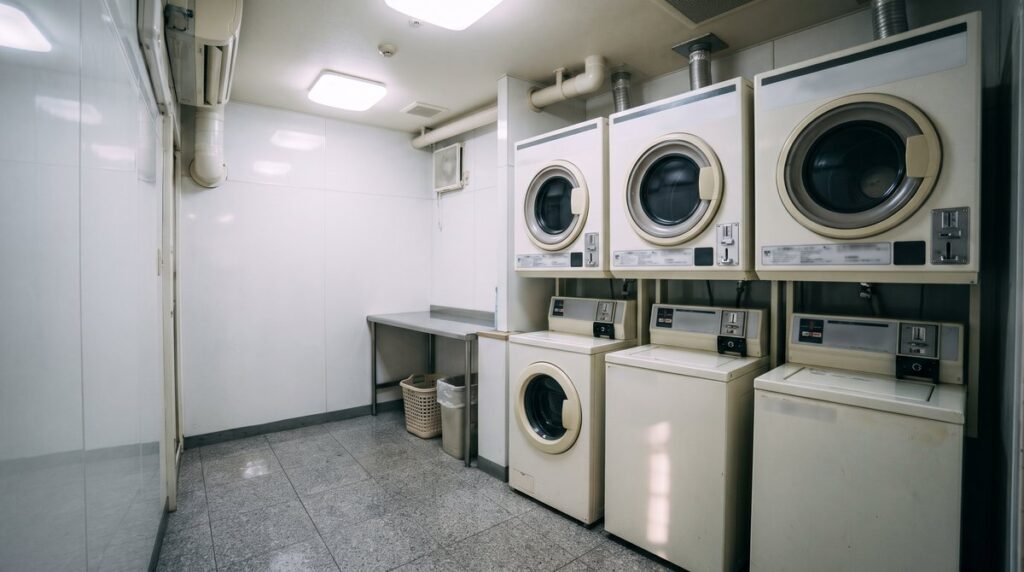
Yes — at least for one stay in every 4–5 days. Many Japanese business hotels have a small coin laundry room for guests, usually with a few washers and dryers on one floor. Luxury hotels are less likely to have self-service machines and tend to offer valet laundry instead, which is billed per item.
When you book, check the property’s facility list for “coin laundry” or “guest laundry” rather than “laundry service” — the latter usually means the hotel sends your clothes out. A few things to know about hotel machines:
- Hotel laundry rooms are small and fill up in the evening. Try early morning or right after check-in.
- Some hotels have all-in-one washer-dryers that can take 2–3 hours per load. A coin laundry down the street with separate dryers is often faster.
- Detergent may or may not be included. Check the sign before you buy a packet at the front desk.
If your hotel doesn’t have machines, you’ll almost certainly find a coin laundry nearby — there are 1,556 self-service laundries on our Tokyo coin laundry map, and 946 of them are open 24 hours.
How do I use a coin laundry in the city?
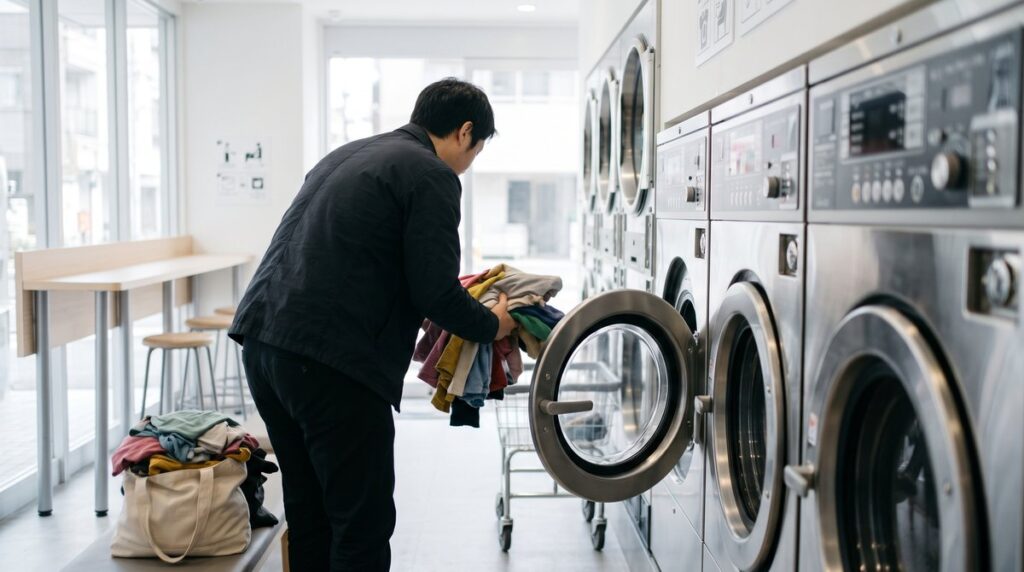
Using a Japanese coin laundry is easy once you’ve done it once. The short version:
- Find one near your hotel on the map, or browse by ward (for example Shinjuku).
- Bring 100-yen coins — about ten of them. Not every shop has a bill changer, and only some take IC cards like Suica.
- Most washers dispense detergent automatically. If you’re not sure, read Do you need detergent at a Japanese coin laundry?
- Use a washer-dryer combo if you want to leave and come back once, or a separate washer + dryer if you want it done faster.
- Come back on time. Leaving clothes in a machine for an hour is the fastest way to annoy the locals — see our etiquette guide.
Our step-by-step guide covers the buttons and Japanese labels in more detail.
A sample 21-day laundry plan
| Day | Where you are | Laundry plan |
|---|---|---|
| 1–4 | Tokyo | Wear what you packed |
| 5 | Tokyo | Load #1 at a coin laundry near your hotel (evening after dinner) |
| 6–9 | Hakone / Kyoto | Book a hotel with guest laundry here |
| 10 | Kyoto | Load #2 in the hotel laundry room (early morning) |
| 11–14 | Osaka | — |
| 15 | Osaka | Load #3 (coin laundry, combine with a long lunch) |
| 16–20 | Back in Tokyo | — |
| 20 | Tokyo | Load #4 — at least two nights before departure, not the last night |
Notice that every laundry day is attached to something you were going to do anyway: dinner, breakfast, a slow lunch. A wash-and-dry takes 60–90 minutes; there’s no reason to sit and watch it.
What about the rainy season and winter?
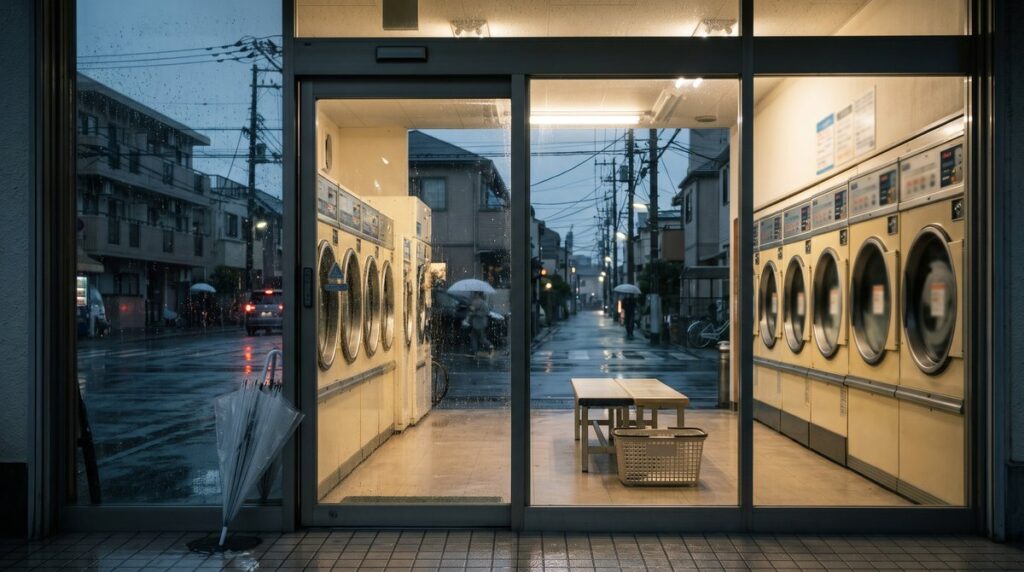
Rainy season (tsuyu): June to mid-July
In the Kanto region (which includes Tokyo), the rainy season normally runs from about June 7 to July 19, according to the Japan Meteorological Agency’s 1991–2020 averages. The actual dates shift every year. During tsuyu:
- Clothes hung in your hotel room won’t dry overnight. Plan to use a dryer every time.
- Coin laundries get busy on rainy weekends, because locals who usually line-dry at home bring their laundry in. Go early in the morning or late at night.
- Pack one extra day of socks — wet shoes mean wet socks.
Winter (December to February)
Tokyo winters are dry and mostly sunny. Hotel rooms are heated and the air is dry, so a T-shirt or merino top hung on a hanger often dries overnight. This is the easiest season for hand-washing a few items in the sink between laundry days. Bulky winter layers are the problem: a down jacket needs a low-heat dryer and plenty of time (our futon and comforter guide covers large items).
What mistakes do travelers make most often?
These come up again and again in Reddit and Tripadvisor threads:
- Packing for the whole trip. Two weeks of clothes means a heavy suitcase on narrow station stairs and overhead racks. You’ll do laundry anyway.
- Leaving laundry until the last night. If the machines are busy or the dryer leaves things damp, you’re packing wet clothes. Do your final load two nights before you fly.
- Feeding the dryer only ¥100. One ¥100 coin buys about 8–10 minutes — not enough for a full load. Budget ¥300–500 for drying (see our pricing breakdown).
- Putting everything on high. Japanese gas dryers can shrink cotton and ruin activewear. Separate delicates.
- No coins. Many shops are unstaffed and some have no bill changer. Keep a stash of 100-yen coins from convenience-store purchases.
- Overloading. A machine stuffed to the top won’t clean or dry properly. Use a larger machine instead.
- Japan-only data plans from ¥390
- Buy online in English, install by QR code
- Use Google Maps to find laundromats on the go
Frequently asked questions
Q: Can I really get by with 5 days of clothes for 3 weeks in Japan?
Yes. With a wash every 4–5 days, you’ll do about four loads. Japan has thousands of coin laundries, and many business hotels have guest machines, so finding one is rarely the problem.
Q: How much will laundry cost over a 3-week trip?
Four loads at ¥600–1,000 each comes to roughly ¥2,400–4,000 ($16–27). Hotel guest laundries are often a little cheaper; hotel valet services are much more expensive.
Q: How long does one load take?
Plan on 30–40 minutes to wash and 30–40 minutes to dry at a coin laundry. All-in-one washer-dryers take about 60–90 minutes at a coin laundry, and can take longer in hotels.
Q: Do I need to bring detergent?
Usually not. Most Tokyo coin laundry washers add detergent automatically. Hotel guest laundries vary — some sell detergent at the front desk or from a vending machine.
Q: Is it OK to hand-wash in my hotel room?
A few small items in the sink is fine and common. Hang them in the bathroom or near the air conditioner, and don’t hang wet laundry over the room’s furniture or lamps.
Q: When is the worst time to do laundry in Tokyo?
Rainy weekends and weekday evenings tend to be busiest. Early mornings are usually quiet, and 24-hour shops are an easy option if you’re jet-lagged.
Last verified: November 2026
Sources
- Japan Meteorological Agency — normal rainy-season dates, Kanto-Koshin region (1991–2020): https://www.data.jma.go.jp/cpd/baiu/kako_baiu09.html
- Electrolux Professional Japan — coin laundry dryer temperature settings: https://www.electroluxprofessional.com/jp/blog/0024/
- Tokyo Coin Laundry Guide — store counts (1,556 locations, 946 open 24 hours), November 2026: laundry-navi.com/en/