
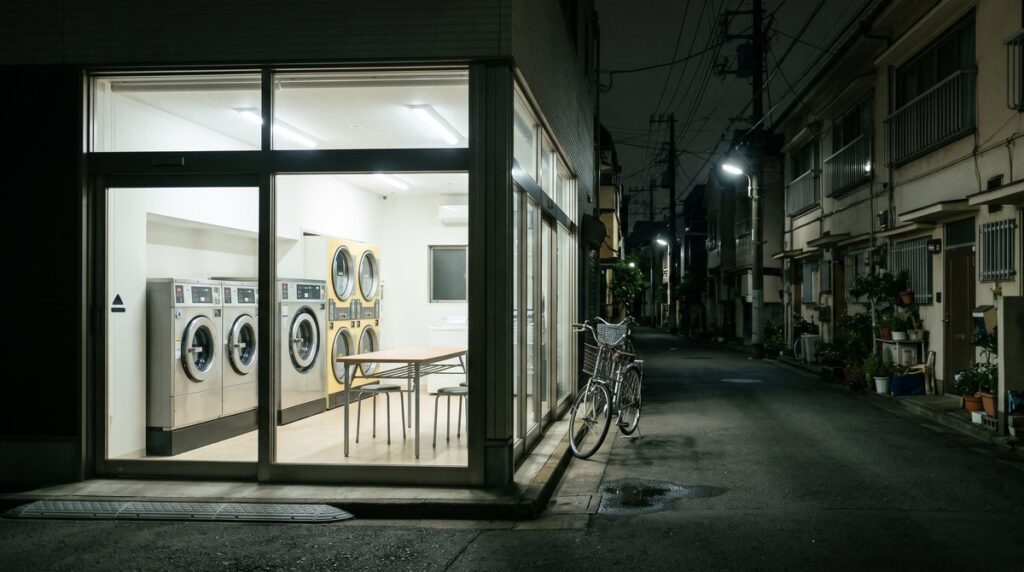
Jet lag has you wide awake at 2 a.m., your hotel’s laundry room closed at 10 p.m., and you’re out of clean socks. In Tokyo that’s not a problem: a large share of the city’s coin laundries never close. Here’s how common 24-hour laundromats are, when they’re quietest, whether they’re safe late at night, and the unwritten rules for using one after dark.
Quick answer: About 6 in 10 Tokyo coin laundries are open 24 hours — 946 of the 1,556 self-service laundries on our map. They’re usually busiest on weekday evenings (roughly 18:00–21:00) and on rainy weekends, and quietest very late at night and early in the morning. Most are glass-fronted, brightly lit and fitted with security cameras, and Tokyo is generally a safe city at night — but stay with your laundry or come back on time, keep the noise down, and bring 100-yen coins because a bill changer or cashless payment isn’t guaranteed. (Prices converted at roughly ¥150 = $1.)
- Filter: Tokyo hotels with washing machines
- Compare prices for Shinjuku, Asakusa, Ginza and more
- Free cancellation on many rooms
How many coin laundries in Tokyo are open 24 hours?
Our directory tracks 1,556 public self-service coin laundries across Tokyo’s 23 wards and the Tama area. Here’s how the late-night picture breaks down:
| Feature | Locations | Share |
|---|---|---|
| Open 24 hours | 946 | ~61% |
| IC card / cashless payment | 474 | ~30% |
| Open 24 hours and cashless | 396 | ~25% |
| All locations | 1,556 | 100% |
Source: Tokyo Coin Laundry Guide listings, November 2026. Hours are checked monthly against chain websites.
Most of the remaining 40% or so open early (5:00–7:00) and close between 22:00 and 1:00. Don’t be confused by times like “5:00–25:00” on Japanese signs — 25:00 means 1:00 a.m. the next morning.
To see only 24-hour shops, tap the “24 hours” filter on our Tokyo coin laundry map. You can stack it with the “IC card / cashless” filter if you’re short on coins. Ward pages like Shinjuku and Shibuya list every location with its hours.
When are 24-hour laundromats busiest — and when are they empty?
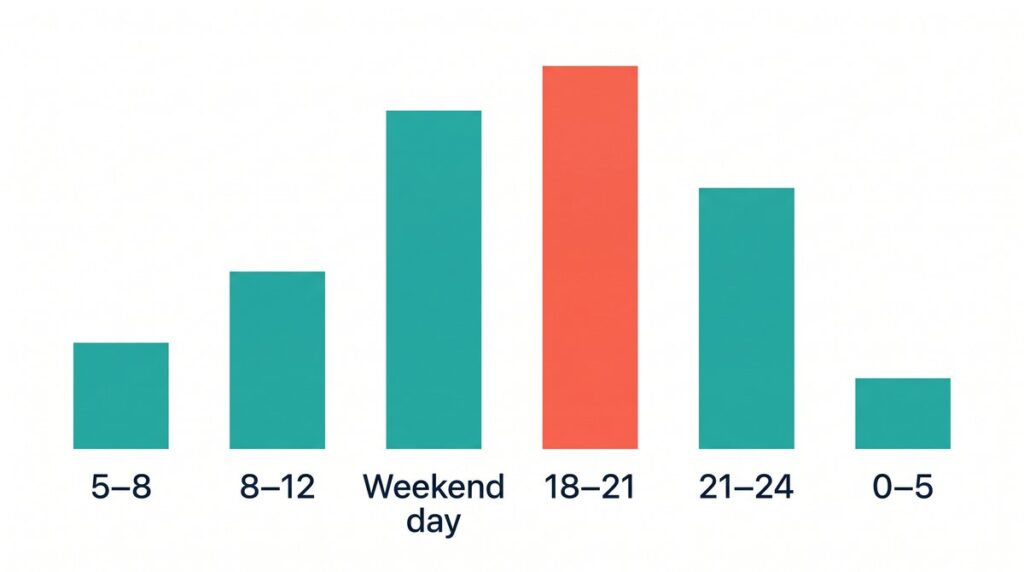
Nobody publishes city-wide usage data, but the general pattern in residential Tokyo is consistent:
| Time | How busy | Who’s there |
|---|---|---|
| 5:00–8:00 | Quiet | Early risers, a few night-shift workers |
| 8:00–12:00 (weekdays) | Quiet to moderate | Retirees, parents, people dropping off futons |
| Weekend daytime | Busy | Families with big loads and bedding |
| 18:00–21:00 (weekdays) | Busiest | People on the way home from work |
| 21:00–24:00 | Moderate, easing off | Late commuters, students |
| 0:00–5:00 | Usually empty | Night owls, jet-lagged travelers |
Weather matters as much as the clock. Many Tokyo households line-dry at home, so after a few days of rain — especially in the rainy season, normally early June to mid-July — dryers fill up fast. The first sunny morning after a long rainy spell is the opposite: everyone’s back to their balconies.
Some chains show live machine status online. Coin Laundry Pierrot’s official store pages include a “current status” (現在の稼働状況) table for each machine, and Baluko Laundry Place lets you operate and pay for machines through its app. Check before you walk over.
Is it safe to do laundry late at night in Tokyo?
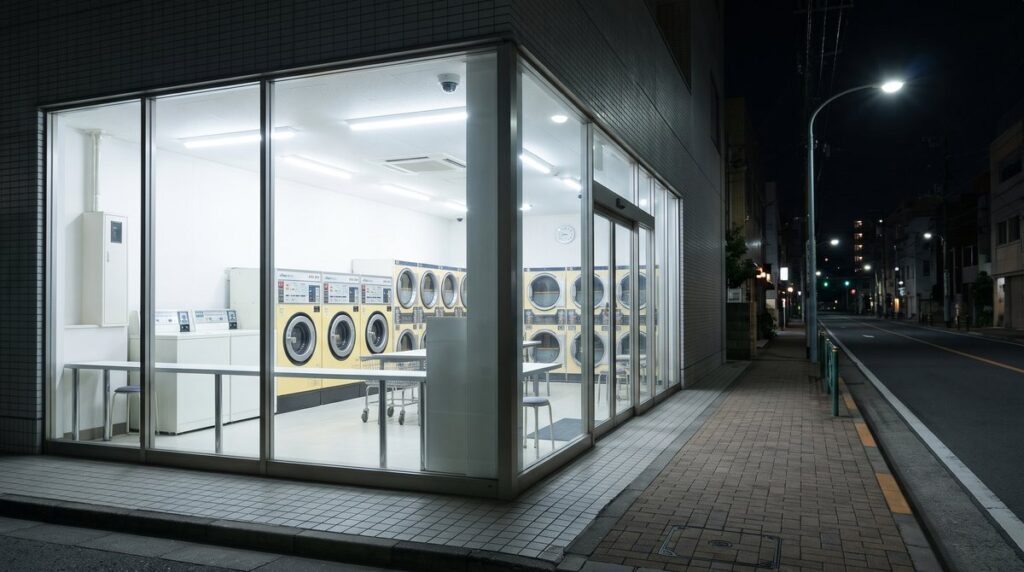
Tokyo is generally a safe city to walk around at night, and a 24-hour coin laundry is usually a calm place to spend an hour. Many are designed to be visible from the street:
- Glass fronts and bright lighting. Most newer chain stores have floor-to-ceiling windows, so the inside is visible from the sidewalk.
- Security cameras. Most unstaffed laundries have cameras and post a notice saying so (look for 防犯カメラ, “security camera”).
- A posted contact number. Unstaffed shops list a phone number for machine trouble — useful if a machine eats your coins.
Common-sense steps still apply:
- Choose a shop on a main road or near a station rather than at the end of a dark side street, especially if you’re walking alone.
- Don’t leave your phone, wallet or passport on a folding table while you step outside.
- If you leave during a cycle, come back on time. Theft from coin laundries isn’t common, but unattended laundry is the easiest thing to take — and other customers may move it if it sits too long.
- In an emergency in Japan, call 110 for police and 119 for fire or ambulance.
For a look at hygiene and cleanliness, including late-night visits, see Are Japanese coin laundries clean?
What’s the late-night etiquette?
Coin laundries are often on the ground floor of apartment buildings, with residents sleeping a few meters above. The rules are mostly about noise and timing:
- Keep it quiet. No phone calls on speaker, no music without headphones, and keep conversations low. Close machine doors gently.
- Don’t hang around outside. Chatting or smoking outside the entrance at 1 a.m. carries straight into the apartments above.
- Don’t leave laundry sitting. At night there may be only a few machines in use, but leaving a finished load for an hour is still bad form. Set a timer.
- No eating or drinking unless the shop clearly allows it — many post signs against it.
- Clean the lint filter if the shop asks you to, and take your empty bags and bottles with you.
- Don’t use the shop as a place to rest. Sleeping on the benches or charging your devices for hours isn’t what the space is for.
Our full coin laundry etiquette guide covers what to do if someone’s laundry is still in the machine you need.
How do I pay at night?
Most 24-hour laundries are unstaffed, so at 3 a.m. there’s nobody to make change. Plan ahead:
- Carry 100-yen coins. A full wash-and-dry takes roughly ¥600–1,000 ($4–7) — six to ten coins. Convenience stores are open all night if you need to break a bill by buying something small.
- Don’t count on a bill changer. Many shops have one (両替機, ryōgaeki) that turns ¥1,000 notes into ten 100-yen coins, but not all do — and they can run out of coins late at night.
- IC cards and apps help. About 30% of the laundries on our map are flagged for IC-card or cashless payment. Look for the Suica/PASMO reader or a QR code on the machine.
- Machines don’t give refunds. If a machine malfunctions, note its number and call the operator’s posted number.
For a full cost breakdown, see How much does coin laundry cost in Tokyo?
- Japan-only data plans from ¥390
- Buy online in English, install by QR code
- Use Google Maps to find laundromats on the go
Frequently asked questions
Q: Are coin laundries in Tokyo open 24 hours?
About 6 in 10 are. On our map, 946 of 1,556 self-service laundries are listed as open 24 hours. The rest typically open around 5:00–7:00 and close between 22:00 and 1:00.
Q: What’s the least busy time to do laundry in Tokyo?
Late at night (after midnight) and early morning (before 8:00) are usually the quietest. Weekday evenings from about 18:00 to 21:00, weekend daytimes and rainy days are the busiest.
Q: Is it safe to go to a coin laundry alone at night?
Generally yes. Most 24-hour laundries are bright, glass-fronted and have security cameras. Choose one on a main street, keep your valuables with you, and don’t leave your laundry for long.
Q: Can I pay with a credit card at night?
Some machines accept IC cards, e-money or app payment, but many still take only 100-yen coins. Bring coins to be safe.
Q: What does “25:00” mean on a laundry sign?
It’s 1:00 a.m. the next morning. Japanese businesses often write late-night closing times past 24:00.
Q: Can I leave my laundry and go back to my hotel?
Only if you come back on time. At night there are fewer people around, but other customers may still need the machine, and unattended laundry is an easy target.
Last verified: November 2026
Sources
- Tokyo Coin Laundry Guide — store counts (1,556 locations; 946 open 24 hours; 474 IC card/cashless; 396 both), November 2026: laundry-navi.com/en/
- Coin Laundry Pierrot (official) — example store page with live machine status: https://laundry.senkaq.com/shop/tokyo/ota-ku/6650/
- Baluko Laundry Place (official) — example store page (24 hours, cashless and app payment): https://baluko.jp/baluko-nishikamata
- Japan Meteorological Agency — normal rainy-season dates, Kanto-Koshin: https://www.data.jma.go.jp/cpd/baiu/kako_baiu09.html