
You pull your favorite T-shirt out of a Tokyo coin laundry dryer and it’s suddenly a size smaller. You’re not imagining it. The big dryers in Japanese coin laundries are commercial gas machines, and on their high setting they blow air hot enough to shrink cotton, warp activewear and crack screen prints. Here’s what each setting actually means and what to do with each fabric.
Quick answer: Japanese coin laundry dryers are mostly gas-fired. One Japanese dryer maker gives the settings as roughly high 70–80°C (158–176°F), medium 60–70°C (140–158°F) and low 50–60°C (122–140°F). Use medium for everyday cotton, low for synthetics, activewear and printed T-shirts, and keep wool, lace and anything labeled “do not tumble dry” out of the dryer completely. High is meant for towels, blankets and futons.
- Filter: Tokyo hotels with washing machines
- Compare prices for Shinjuku, Asakusa, Ginza and more
- Free cancellation on many rooms
Why do Japanese coin laundry dryers run so hot?
Most dryers in Tokyo coin laundries are commercial gas dryers: a gas burner heats air that is blown through a large tumbling drum. They’re built to dry a heavy load quickly — that’s how the shops keep prices at about ¥100 ($0.70) for 8–10 minutes. Electrolux Professional, which supplies coin laundry equipment in Japan, notes that the inside of the drum can go above 80°C, and suggests waiting for the cool-down at the end of the cycle before you pull your laundry out.
Many home dryers in North America and Europe also have high settings, but a big commercial drum with a strong gas burner dries — and heats — a load much faster. If you’re used to a gentle home dryer, treat “high” here as “very high.” (Prices converted at roughly ¥150 = $1.)
What do the temperature settings mean?
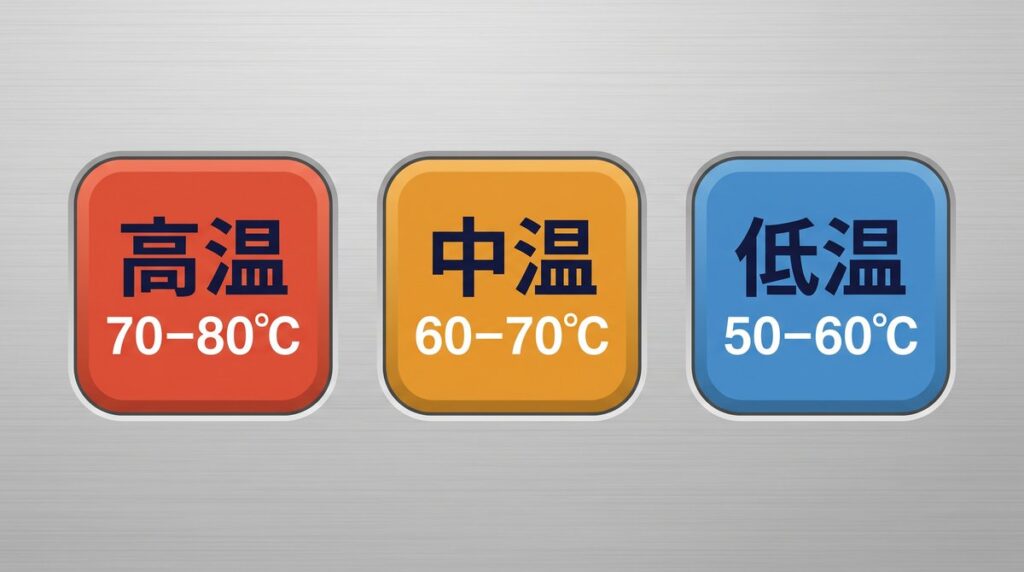
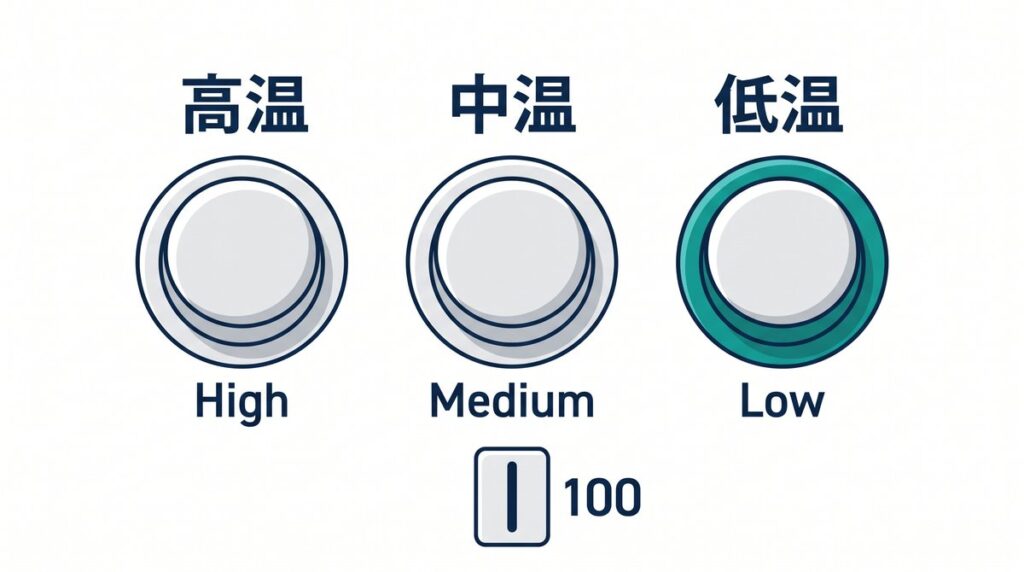
Most dryers have three buttons, labeled in Japanese. Some older machines only have two (high and low), and a few have just one setting.
| Button | Reading | Approx. temperature | Use it for |
|---|---|---|---|
| 高温 | kō-on (high) | 70–80°C / 158–176°F | Towels, sheets, blankets, futons, heavy cotton |
| 中温 | chū-on (medium) | 60–70°C / 140–158°F | Everyday T-shirts, shirts, sweatshirts, jeans |
| 低温 | tei-on (low) | 50–60°C / 122–140°F | Underwear, socks, synthetics, fleece, jackets |
Temperatures are the guidance published by Electrolux Professional Japan. Actual temperatures vary by machine, and the “start” button (スタート) usually comes after you select the temperature.
Match the setting to your care label
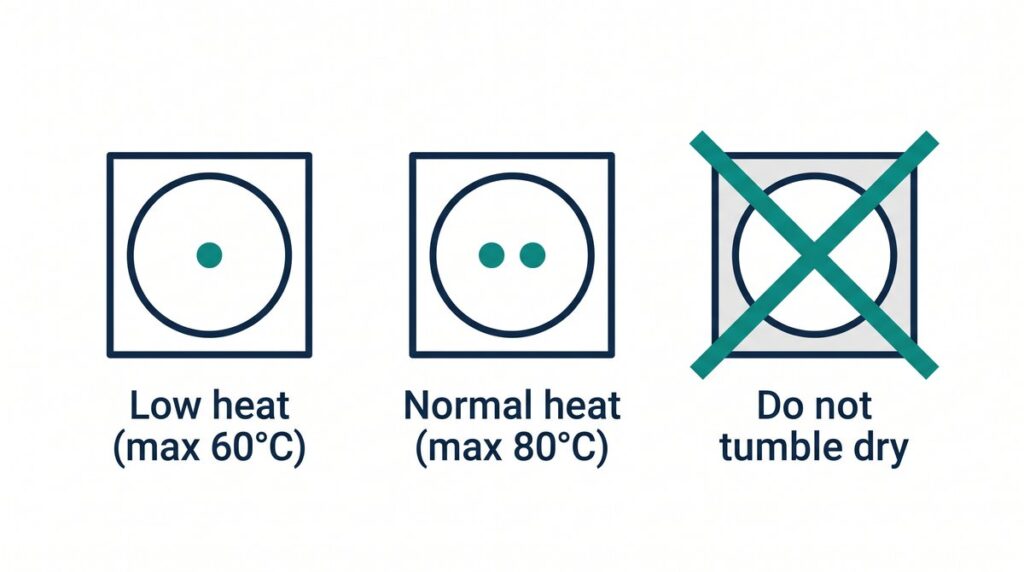
The international care symbols on your clothes use dots inside the tumble-dry symbol (a circle in a square). Under Japan’s care-label system, as summarized by the clothing maker Gunze:
- Two dots: tumble drying OK, high — exhaust temperature up to 80°C. Any setting is fine.
- One dot: tumble drying OK, low only — exhaust temperature up to 60°C. Use 低温 (low).
- Crossed out: do not tumble dry. Hang it to dry.
Labels show the maximum, so dropping to a lower setting is always the safer move.
What shrinks, and what’s safe?
| Fabric / item | Risk on high | What to do |
|---|---|---|
| Cotton T-shirts | Some shrinkage, especially new shirts | Medium; take out while slightly damp |
| Printed / graphic tees | Prints can crack or peel | Turn inside out; low |
| Jeans | Shrink in length and waist | Medium; don’t over-dry |
| Polyester, nylon, activewear | Can warp or go shiny; elastic weakens | Low, short cycle — dries fast anyway |
| Leggings, swimwear, spandex blends | Elastic damage | Low, or hang dry |
| Wool / merino | Felts and shrinks | Don’t tumble dry; hang overnight |
| Cashmere, silk, lace | Damage | Don’t tumble dry |
| Down jackets | Shell and feathers can be damaged by high heat | Low, long cycle; check often |
| Towels, sheets | Low risk | High is fine |
Cotton
Cotton shrinks most the first few times it’s washed and dried hot. A 30–40 minute cycle on medium will dry most T-shirts. Pull them out while they still feel very slightly damp and let them finish on a hanger in your room.
Wool and merino
Merino base layers are popular with travelers because you can wear them several times — but heat plus tumbling is exactly how wool felts. Wash it, then hang it in your hotel room. In winter, Tokyo’s dry indoor air usually dries a thin merino top overnight.
Synthetics and activewear
Polyester and nylon dry quickly, so they don’t need high heat. Low for 20–30 minutes is usually enough. High heat can soften or warp performance fabrics and weaken elastic.
Down
Down jackets and sleeping bags can go in a coin laundry dryer, but on low and for longer — check every 10–15 minutes and break up clumps. Large bedding is covered in our futon and comforter guide.
How do I avoid shrinking my clothes?
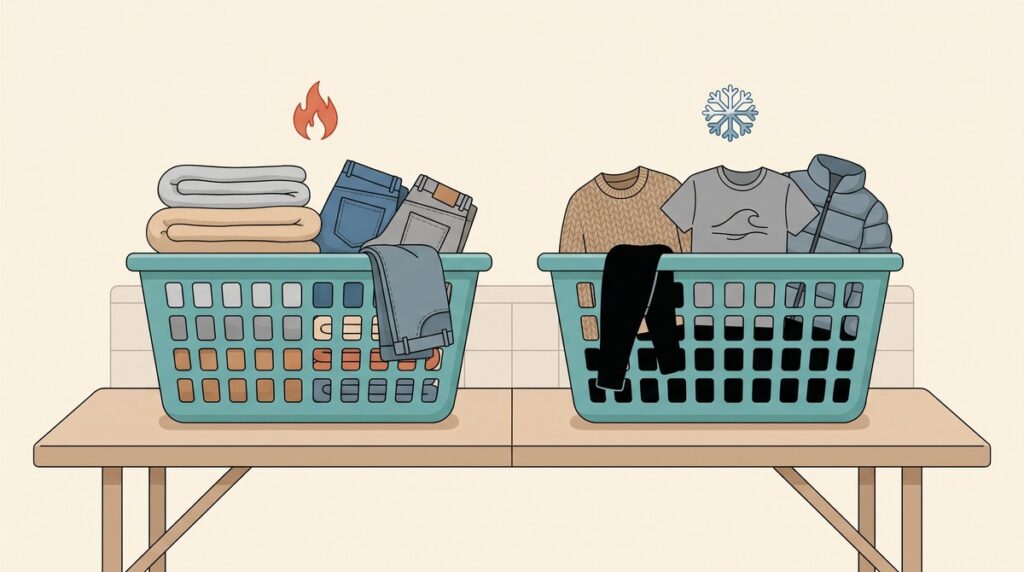
- Split the load. Put towels and jeans in one dryer on high or medium, delicates and synthetics in another on low. Two small loads often cost the same as one long one.
- Buy time in small chunks. Start with ¥200–300 (about 16–30 minutes), check, and add ¥100 if needed. Over-drying causes more shrinkage than the temperature itself.
- Choose the right size. An overloaded drum dries unevenly, so you end up running it longer and hotter.
- Pull things out right away. Clothes sitting in a hot drum keep cooking and wrinkle. (It’s also good coin laundry etiquette.)
- Hang the fragile stuff. Bring a few clothes pegs or use hotel hangers for wool, swimwear and anything with a “do not tumble dry” label.
- Watch combo machines. All-in-one washer-dryers dry at whatever setting the machine chooses or you pick at the start. Don’t put delicates in a combo cycle unless you can choose low heat.
Why are there no dryer sheets?
Dryer sheets just aren’t part of laundry culture in Japan, and you won’t usually see them for sale at coin laundries. Where fabric softener is used, it’s normally added during the wash — many Tokyo coin laundry washers dispense detergent and softener automatically (see our detergent guide).
If you bring your own dryer sheets from home, check the shop’s posted rules first. Some shops restrict what you can add to their machines — liquids, scent beads or sheets — to protect equipment and avoid fragrance complaints from other customers. When in doubt, skip it.
- Japan-only data plans from ¥390
- Buy online in English, install by QR code
- Use Google Maps to find laundromats on the go
Frequently asked questions
Q: How hot is a Japanese coin laundry dryer?
According to Electrolux Professional Japan, the high setting blows air at roughly 70–80°C (158–176°F), medium about 60–70°C and low about 50–60°C. The drum itself can get hotter than 80°C, so let it cool before reaching in.
Q: Will my clothes shrink in a Japanese dryer?
Cotton can shrink a little on high, and wool will felt. Use medium for cotton, low for synthetics and printed items, and hang wool and anything labeled “do not tumble dry.”
Q: Which button is low heat?
低温 (tei-on) is low. 中温 (chū-on) is medium and 高温 (kō-on) is high. Use your phone camera translation app if the labels are different.
Q: How much drying time do I need?
Everyday clothes usually take 30–40 minutes. At about ¥100 per 8–10 minutes, that’s roughly ¥300–500. Synthetics dry faster; towels and jeans take longer.
Q: Can I dry shoes in a regular dryer?
No — use the dedicated sneaker dryer if the shop has one. See Washing sneakers at a Tokyo coin laundry.
Q: Are hotel dryers as hot as coin laundry dryers?
Not necessarily. Some hotels use smaller electric machines or washer-dryer combos that run cooler and slower. Check the panel and the care label either way.
Last verified: November 2026
Sources
- Electrolux Professional Japan — coin laundry dryer settings (high 70–80°C, medium 60–70°C, low 50–60°C) and gas dryers: https://www.electroluxprofessional.com/jp/blog/0024/
- Gunze — Japanese care-label chart (tumble dry high: exhaust max 80°C; low: max 60°C): https://www.gunze.co.jp/support/faq/pdf/mark01.pdf
- Tokyo Coin Laundry Guide — dryer pricing: How much does coin laundry cost in Tokyo?