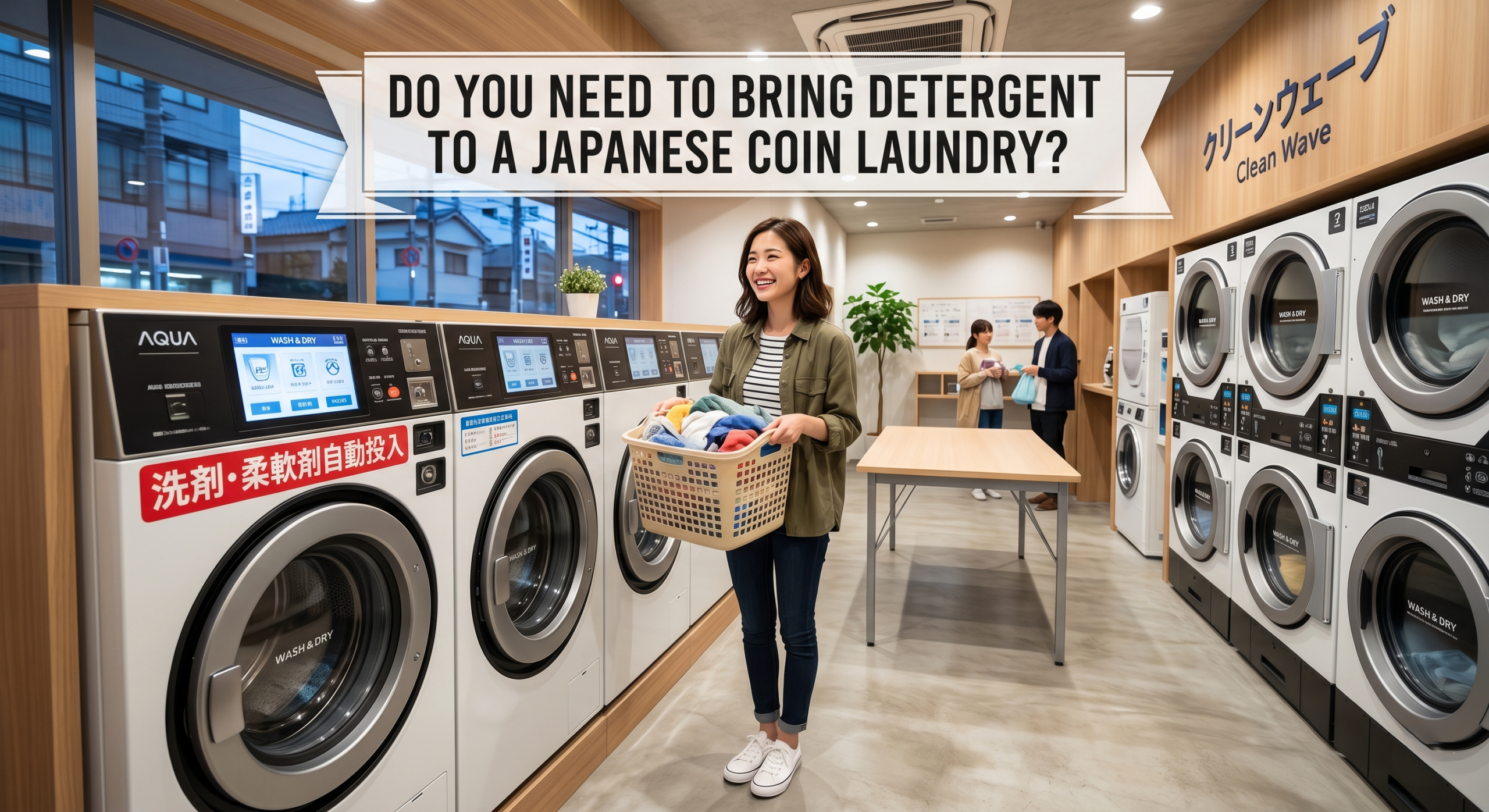
If you’re visiting Japan or recently moved to Tokyo, you might be wondering: do I need to bring my own detergent and fabric softener to the coin laundry?
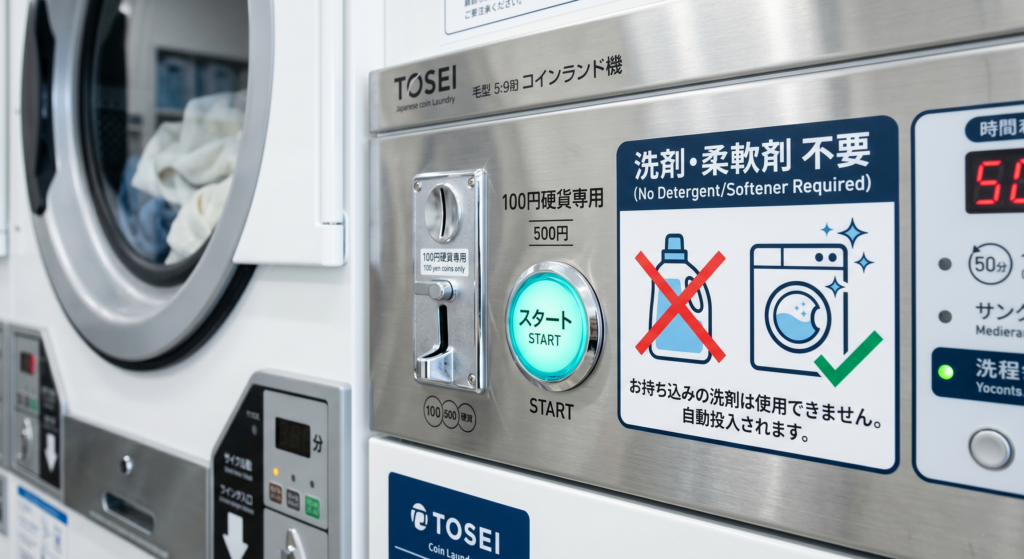
Short answer: No, in almost all cases. Modern Japanese coin laundromats (コインランドリー) automatically dispense detergent and softener as part of the wash cycle. The cost is included in the price you pay.
That said, there are some details and exceptions worth knowing.
Why Most Japanese Coin Laundries Auto-Dispense Detergent
Japanese coin laundry chains have standardized on automatic detergent dispensing for several practical reasons:
- Cleaner machines. Customers don’t accidentally pour detergent into the wrong slot or use too much.
- Convenience. No one wants to lug a detergent bottle to the laundromat at midnight.
- Standardized results. The machine uses the right amount based on load size.
- Reduced spills. Less mess on the floor and walls.
Major chains like Mammachao, Baluko Laundry Place, WASH House, and Coin Laundry Pierrot all use auto-dispense systems on virtually every machine.
How It Works
When you start a wash cycle:
- Insert payment
- Press start
- The machine fills with water and automatically adds the right amount of detergent and softener
- Optionally, in a few high-end machines, you can choose between “standard” and “fragrance-free” via a button
You don’t see or interact with the detergent at all. There’s no slot to pour anything in.
What Detergent Do They Use?
Most Japanese coin laundries use commercial-grade liquid detergent, often a milder formulation than what consumers buy retail. Common characteristics:
- Liquid detergent (not powder)
- Mild floral or fresh scent (some unscented options at newer chains)
- Suitable for most fabric types
- Combined with fabric softener in many machines
If you have a strong scent preference or sensitivity, consider visiting a Baluko Laundry Place — they’re known for using designer-grade detergents and offering scent options.
When You MIGHT Want to Bring Your Own
There are specific cases where bringing your own laundry product makes sense:
1. Skin sensitivities or allergies
If you have eczema, atopic dermatitis, or known detergent allergies, the standard automatic detergent may irritate your skin. In this case:
- Some larger laundromats have a “no detergent” option button (no charge for it)
- You can bring a small bottle of your preferred hypoallergenic detergent and pour it directly into the drum BEFORE starting the cycle (not into a dispenser)
2. Stain pre-treatment
For tough stains (red wine, ink, grass, blood), pre-treat them at home with a stain remover stick before bringing the clothes to the laundromat. The auto-dispensed detergent isn’t designed for tough stains.
3. Wool or delicate items
Standard auto-dispensed detergent is too harsh for wool, silk, and delicate fabrics. Either:
- Use the “delicate” or “wool” cycle if available (some machines auto-adjust detergent strength)
- Wash these items at home or by hand
- Take them to a dry cleaner instead
4. Dryer sheets
Dryer sheets are uncommon in Japan, and Japanese dryers don’t require them. If you really want one, bring a single sheet and toss it in with your clothes — but it’s genuinely not needed for the dryer to work well.
Old / Independent Laundromats: The Exception
Some older, independently-operated coin laundromats in Tokyo (especially in shitamachi areas) may use older machines that don’t auto-dispense. In these cases, you’ll see:
- A small detergent slot or compartment on the machine
- Sometimes a vending machine selling small detergent packets (¥100–200)
- Signs in Japanese explaining how to add detergent
If you walk into a laundromat and see machines with empty detergent slots, you’ll need to either:
- Buy a packet from the on-site vending machine
- Use a different (newer) laundromat nearby
- Bring your own detergent
This is uncommon in modern Tokyo — fewer than 10% of laundromats fall into this category — but it does happen.
What About Fabric Softener?
Most auto-dispense machines include fabric softener as part of the cycle. The result is laundry that smells fresh and feels soft. Some chain laundromats let you toggle softener on/off via a button if you prefer no softener (e.g., for athletic wear, where softener can reduce moisture-wicking).
Special Cycles
Newer machines (especially at Baluko, Mammachao Premium, and similar) offer specialty cycles:
- Antibacterial wash — uses a stronger detergent + sanitizer (¥100–200 extra)
- Wool / delicate — gentler detergent, lower temperature
- Allergen care — extra rinse to remove residual detergent
- Sneaker / shoe wash — separate machine with mild shoe-specific detergent
Quick Reference
| Situation | Bring Own? |
|---|---|
| Standard wash at any major chain (Baluko, Mammachao, WASH House, etc.) | No |
| Sensitive skin / known allergies | Yes (or use “no detergent” option) |
| Specific scent preference | Optional (visit Baluko for scent options) |
| Tough stains | Pre-treat at home; standard detergent is enough for the wash |
| Wool / silk / delicates | Wash at home or take to dry cleaner |
| Old independent laundromat with empty detergent slots | Yes, or buy from on-site vending |
| Dryer sheets | Not needed; bring one if you really want |
Bottom Line
For 90%+ of coin laundry visits in Tokyo, you don’t need to bring anything except your laundry and coins. Walk in, load up, pay, and walk out 30 minutes later with clean clothes. The detergent (and softener) handle themselves.
For more on Japanese coin laundry basics, see our complete guide, or browse coin laundromats by ward to find one near you.