Older guides to Japanese laundromats say “bring 100-yen coins” and stop there. That is still the safest advice, but in 2026 a growing number of Tokyo stores also take IC cards, QR codes or app payments. Here is how to tell what a particular store accepts before you load your clothes.
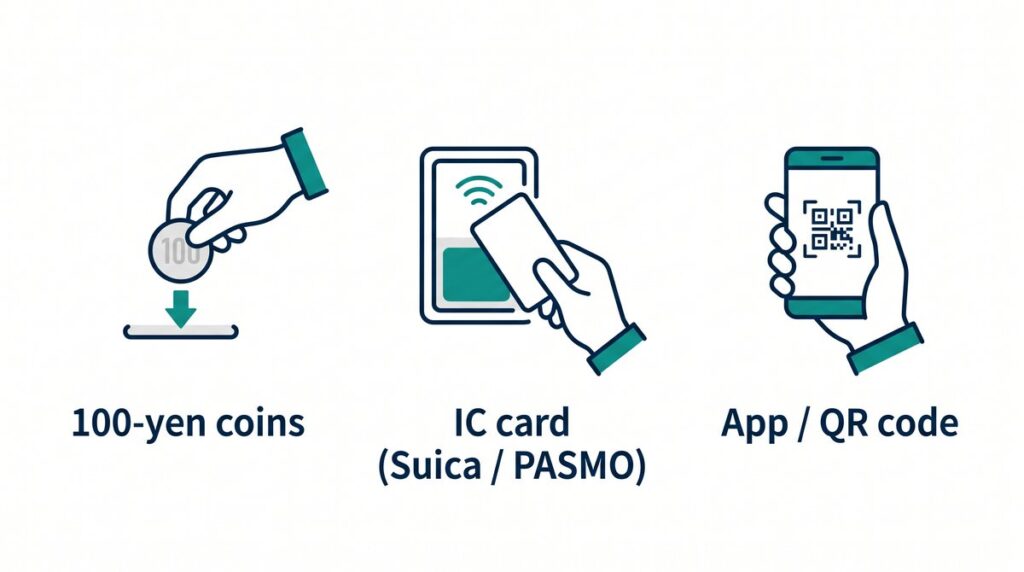
Quick answer: Bring ¥1,000–2,000 in 100-yen coins or 1,000-yen notes; nearly every Tokyo coin laundry takes cash, and most have a change machine. Look for the 電子マネー (e-money) or 交通系IC logo on a machine if you want to tap Suica or PASMO. Card and QR payment usually go through a chain’s own app or a central payment terminal, and coverage varies store by store.
- Filter: Tokyo hotels with washing machines
- Compare prices for Shinjuku, Asakusa, Ginza and more
- Free cancellation on many rooms
Payment methods at a glance
| Method | How common in Tokyo | What to look for | Notes for visitors |
|---|---|---|---|
| 100-yen coins | Almost universal | Coin slot on each machine | Machines usually give no change |
| 1,000-yen notes | Via change machine | 両替機 (ryōgaeki) on the wall | Larger notes are often not accepted |
| Transit IC (Suica, PASMO) | A minority of stores | 電子マネー, 交通系IC or the IC logo | Tap the reader before choosing a course |
| QR code (PayPay etc.) | Some chains, often via app | コード決済, PayPay logo | Mostly used by residents |
| Credit card | Mostly via chain apps or central terminals | クレジット, card brand logos | Apps may be Japanese only and need registration |
| Store prepaid card | Common at chains | 専用ICカード, プリペイドカード | Usually works only at the issuing store; not worth it for a short trip |
In the laundry-navi database, about 474 of the roughly 1,556 Tokyo stores we list publicly show some form of IC card or e-money payment, so around three in ten. Cash remains the default.
Coins and the change machine
Washers and dryers in Japanese coin laundries are built around the 100-yen coin. A typical visit looks like this, with USD at about ¥150 = $1:
| Item | Typical price | 100-yen coins needed |
|---|---|---|
| Washer, medium load | ¥400–600 (≈ $3–4) | 4–6 |
| Washer-dryer, full course | ¥800–1,200 (≈ $5–8) | 8–12 |
| Dryer | ¥100 per 8–10 minutes (≈ $0.70) | 3–4 for a normal load |
| Detergent from a vending machine (if needed) | ¥30–100 | 1 |
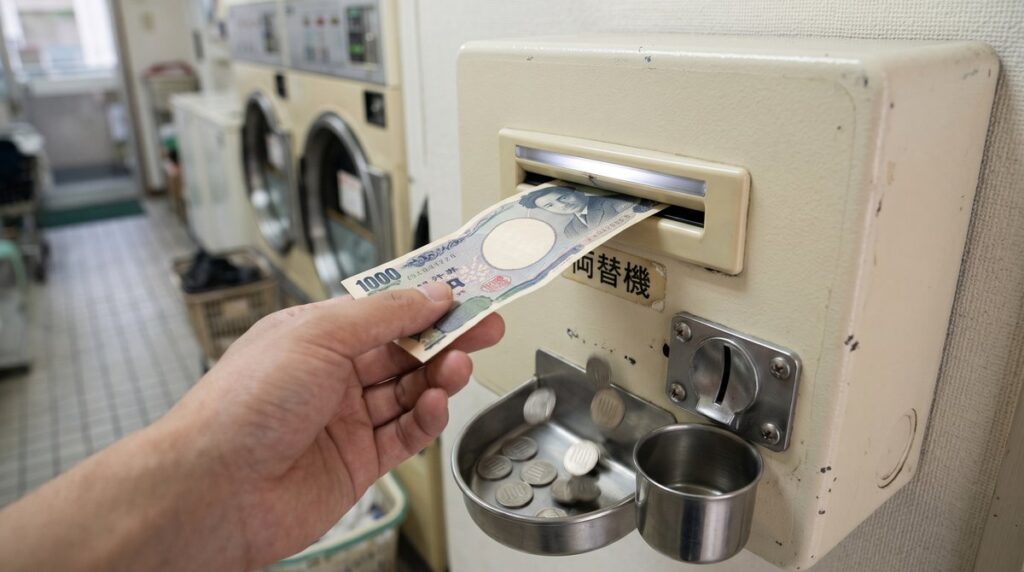
The change machine (両替機) is usually on the wall near the entrance and takes 1,000-yen notes. Baluko, for example, tells customers to break notes at the in-store change machine because the washers give no change. Many change machines do not take 5,000- or 10,000-yen notes, so break them at a convenience store first. Some newer stores replace the change machine with a central payment terminal that accepts 100-yen coins, 500-yen coins and 1,000-yen notes and gives change; Coin Laundry Pierrot uses this setup at some branches.
Suica, PASMO and other IC cards
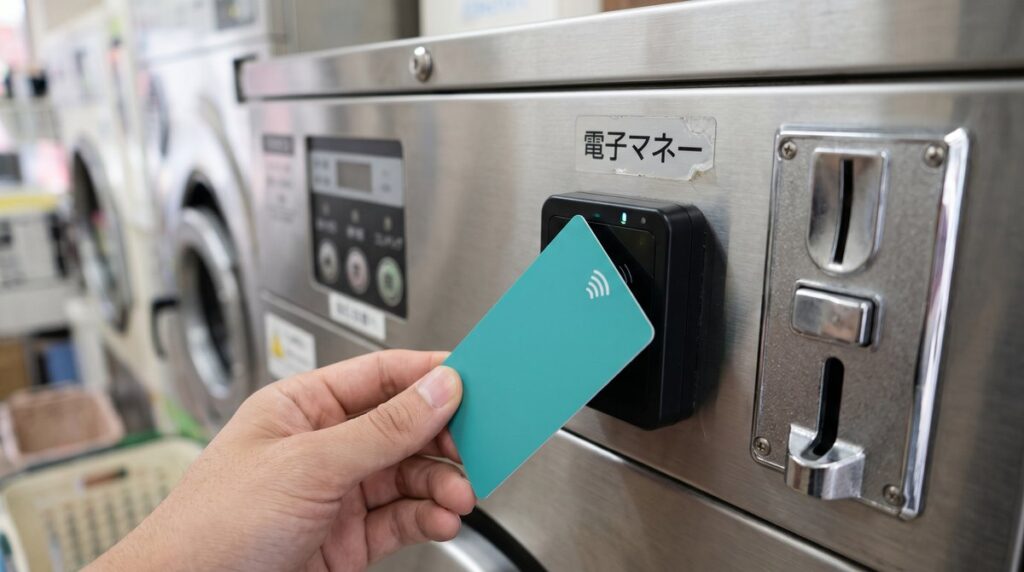
Transit IC cards are the easiest cashless option for visitors, because you probably already have one for the train. Stores that accept them show a logo or sticker on the machine or the payment terminal. Words to look for:
- 交通系IC (kōtsūkei IC): transit IC cards such as Suica and PASMO
- 電子マネー (denshi manē): e-money in general; check which logos are shown
- キャッシュレス (kyasshuresu): cashless payments accepted
Hotel guest laundries are starting to add IC readers too. The Keio Plaza Hotel’s guest laundry page lists 100-yen coins and 12 types of e-money, and Daiwa Roynet Hotel Kyobashi Premier lists transit IC cards for its laundry. At most other hotels, plan on coins.
Can tourists get Suica?
Yes. On an iPhone, JR East’s Welcome Suica Mobile app (iOS 17.2 or later) issues a digital Suica with no deposit; the balance expires 180 days after issue and is topped up with the card in your Apple Pay. Apple Wallet can also create a standard Suica in Japan. Whatever you use, a Suica balance works at laundromat readers that show the transit IC logo.
Apps, QR codes and credit cards
Large chains increasingly run their own apps. These are useful if you live in Tokyo, less so for a one-week visit, because they are often in Japanese and require registration.
| Chain | Cash | Cashless options (from official pages) |
|---|---|---|
| Baluko Laundry Place | Coins, in-store change machine | Baluko app (credit cards such as Visa, Mastercard and JCB, plus PayPay); Smart Laundry app (cards and QR wallets); store card. Some options only at some stores. |
| WASH House | Coins accepted for extra time and drying | App with cashless payment at all stores (card and cashless; specific brands not listed) |
| Coin Laundry Pierrot | Coins; 500-yen coins and 1,000-yen notes at stores with a multi-terminal | App with code (QR) payment at 5% off; store prepaid IC card; e-money at some branches |
| mammaciao | Coins | E-money and prepaid cards at some stores (details vary) |
QR wallets such as PayPay are set up mainly for residents and typically need a Japanese phone number to register, so most short-term visitors will not use them. If a chain app accepts foreign credit cards, it can be a way to pay without coins, but test it before you need it.
How to check a store before you go
- Look at the store listing. Our ward pages, such as Shinjuku, Shibuya and Taito, include IC and payment notes where known.
- Look at the door or wall. Payment logos are often on a sticker at the entrance or on the change machine.
- Look at the machine itself. A small card-reader pad next to the coin slot means IC payment on that machine. Not every machine in the same store may have one.
- Always carry coins as backup. Readers break, apps log you out, and dryer top-ups are often coin-only even where the washer takes cards.
Common payment problems
“The machine took my coins but didn’t start”
Coin laundry machines usually need you to choose a course and then press スタート (start). The display shows 投入金額 (amount inserted). If nothing happens, check the door is firmly shut. If the machine is broken, there is usually an emergency phone number on the wall; call it and the operator will tell you how refunds are handled.
“I tapped my card and nothing happened”
Some readers need you to choose the course first and tap second, and some the reverse. Check the instructions on the reader, and make sure your Suica balance covers the full price.
“The dryer only takes coins”
This is normal. Even at stores with cashless washers, dryers are often coin-only, and WASH House notes that coins can be used to add drying time. Keep a few 100-yen coins.
For full price ranges see our Tokyo coin laundry pricing guide, and for the Japanese labels on payment screens see the buttons and kanji cheat sheet.
- Japan-only data plans from ¥390
- Buy online in English, install by QR code
- Use Google Maps to find laundromats on the go
FAQ
Q: Do Japanese coin laundries take credit cards?
A: A minority do, usually through a chain app or a central payment terminal rather than at each machine. Cash in 100-yen coins works everywhere.
Q: Can I use Suica or PASMO at a laundromat in Tokyo?
A: At stores and machines that show the transit IC or 電子マネー logo, yes. Around three in ten stores in our Tokyo database list IC card or e-money payment.
Q: How many 100-yen coins do I need for laundry in Japan?
A: About 8–12 for a full wash-and-dry course, or 4–6 for a wash plus 3–4 for the dryer. Bring ¥1,000–2,000 in coins or 1,000-yen notes.
Q: Do coin laundries in Japan have change machines?
A: Most do, and they usually take 1,000-yen notes. Some hotel laundry rooms do not, so get coins at the front desk first.
Q: Can tourists use PayPay at laundromats?
A: PayPay is accepted by some chains, but it is set up mainly for residents, so most visitors will find coins or Suica easier.
Q: Do Japanese laundry machines give change?
A: Individual machines usually do not. Central payment terminals at some newer stores do. Insert exact amounts where possible.
Last verified: November 2026. Payment options change as stores upgrade equipment; check the machine before you load it.
Sources
- Baluko Laundry Place, how to use self laundry: https://baluko.jp/self-laundry
- Baluko Laundry Place, Q&A (app and payment): https://baluko.jp/qa
- WASH House, how to use (app payment, extra drying): https://www.wash-house.jp/howto/index8.php and https://www.wash-house.jp/howto/index9.php
- Coin Laundry Pierrot (Senkaku), FAQ: https://laundry.senkaq.com/faq/
- mammaciao, official site and e-money news: https://mammaciao.com/ and https://mammaciao.com/news/17341
- Keio Plaza Hotel Tokyo, guest laundry room: https://www.keioplaza.co.jp/en/stay/info/landryroom/
- Daiwa Roynet Hotel Tokyo Kyobashi Premier, facilities: https://www.daiwaroynet.jp/tokyo-kyobashi/facilities/
- Welcome Suica Mobile (East Japan Railway Company), App Store listing: https://apps.apple.com/us/app/-/id6738336566
- Apple Support, add Suica to Apple Wallet: https://support.apple.com/en-us/108772
- laundry-navi.com Tokyo coin laundry database (IC/e-money flags), November 2026